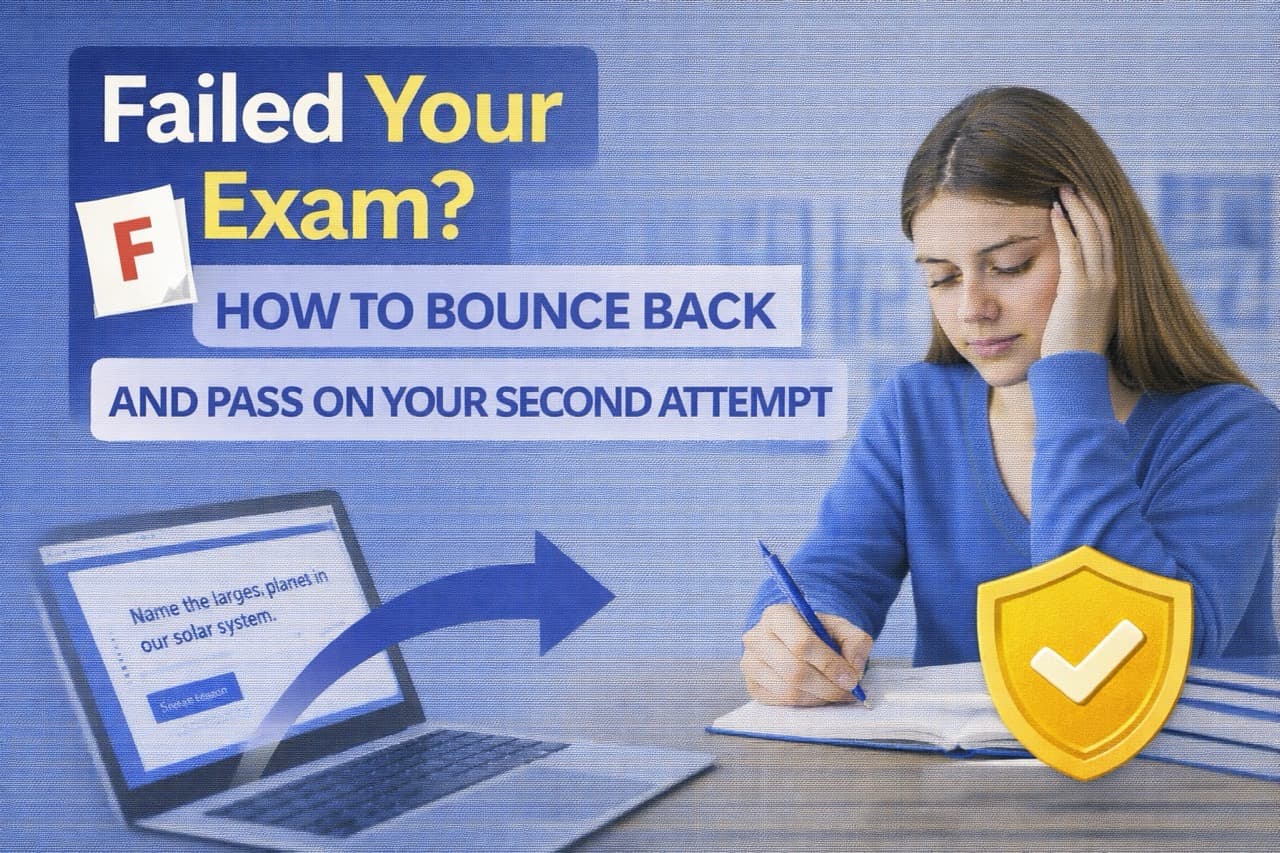
You checked your score. Your stomach dropped. You failed. Maybe it was a certification exam you studied months for. Maybe it was a licensing test your career depends on. Maybe you just failed your first college exam and have no idea what went wrong. Here is the truth nobody tells you: failing an exam does not mean you cannot pass. It means you have not passed yet. And with the right failed exam retake tips, your second attempt can be the one that counts.
This guide is for students who just failed and feel lost. For professionals whose career advancement hit an unexpected wall. For anyone staring at a failed score wondering what to do next. We are going to cover exactly what to do after failing an exam, how to build a retake exam strategy that actually works, and how to turn this setback into the motivation you need to finally pass.
Because here is what the data shows: many people pass on their second attempt. Some exams even have higher pass rates for retakers. Why? Because failing gives you something first-time test takers do not have - real experience with the actual exam. Let us make sure you use that experience wisely.
You Failed Your Exam - Now What?
First things first: breathe. A failed exam feels devastating in the moment, but it is not the end. Not even close. Before you do anything else, allow yourself to feel whatever you are feeling - disappointment, frustration, maybe embarrassment. Those emotions are valid. But they should not drive your next decisions.
Here is what to do in the first 48 hours after seeing that fail notification:
Step 1: Get Your Score Breakdown
Most exams provide more than just pass or fail. Request or access your score report that shows performance by section or topic area. This is gold for your exam retake preparation. You need to know exactly where you struggled, not just that you did not pass.
- Certification exams (CompTIA, PMP, etc.) typically provide section-by-section breakdowns
- Nursing exams like NCLEX provide performance by content area and client needs category
- Graduate entrance exams (GRE, GMAT, LSAT) show detailed section scores
- State licensing exams often provide topic area performance
Step 2: Check Your Retake Policy
Every exam has different rules for retakes. Some key questions to answer:
- How long must you wait before retaking? (Ranges from 24 hours to 90 days depending on the exam)
- Is there a fee for retaking?
- Are there limits on total attempts?
- Does the exam version change, or will you see similar questions?
Understanding the exam retake rules helps you plan realistically. If you have a 45-day wait for NCLEX, you have time to make significant changes. If your real estate exam allows a retake next week, your strategy will be more focused.
Step 3: Do an Honest Assessment
This is the hard part. You need to honestly evaluate why you failed. Not what you want to believe, but what actually happened. Ask yourself:
- Did you study enough total hours?
- Did you study the right material? (Many students study the wrong things)
- What study methods did you use? (Passive reading? Active recall?)
- Were you dealing with test anxiety that blocked your performance?
- Did you run out of time during the exam?
- Were the questions harder than expected?
Be brutally honest. If you only studied for two weeks when you needed two months, that is good information. If you read notes repeatedly but never actually tested yourself, that explains a lot. The diagnosis shapes the treatment.
Why Students Fail Exams (And Why It Is Not Always What You Think)
Here is something that might surprise you: most people who fail exams are not stupid. They are not lazy. Many of them studied hard. The problem is usually how they studied, not whether they studied.
The Illusion of Competence
This is the most common trap. You read your notes and the material feels familiar. You watch a video and think "yeah, I know this." You highlight key points and feel productive. But familiarity is not the same as knowledge. Recognition is not the same as recall.
On exam day, nobody hands you notes and asks if they look familiar. You have to retrieve information from memory, apply concepts to scenarios, and make decisions under pressure. If you never practiced doing that, the exam will expose the gap between what you thought you knew and what you actually knew.
Common Reasons Students Fail:
- Passive studying: Re-reading, highlighting, and watching videos without testing yourself
- Wrong material: Studying content that is not on the exam or skipping content that is
- No practice questions: Never experiencing exam-format questions before test day
- Poor time management: Running out of time during the actual exam
- Test anxiety: Knowing the material but blanking under pressure
- Inadequate preparation time: Starting too late and cramming
If you want to understand why you failed, you need to identify which of these (or which combination) affected you. Our guide on active recall and spaced repetition explains the science behind effective studying - and why most popular study methods do not work.
Your Retake Exam Strategy: A Step-by-Step Plan
Now for the part you came here for - how to actually pass on your second attempt. This retake exam strategy has helped thousands of students turn a failing score into a passing one.
Week 1: Analysis and Planning
Before you study a single flashcard, you need a plan. This week is about understanding what went wrong and designing a better approach.
- Review your score breakdown: Identify your weakest areas. These get priority in your new study plan.
- Audit your previous study approach: What methods did you use? How much time did you actually spend? Where were the gaps?
- Research the exam format: Make sure you understand exactly how the test works - question types, time limits, passing criteria.
- Create a study schedule: Be realistic about how much time you have and how much you can actually do per day.
- Gather better resources: If your study materials had gaps, find additional or replacement resources.
Weeks 2-4: Focused Content Review
Now you study - but differently. Prioritize your weak areas from the score breakdown. Use active recall instead of passive reading. Test yourself constantly.
The 70/30 Rule for Retakes:
Spend 70% of your study time on your weak areas and 30% on maintenance review of areas you passed. It is tempting to study what you already know (it feels good), but that will not move the needle. Focus on fixing what is broken.
Key study strategies for your retake:
- Use active recall - close your notes and try to remember information before checking
- Practice with questions that match the exam format
- Review wrong answers thoroughly - understand why you missed them
- Space out your study sessions rather than cramming
- Teach the material to someone else (or pretend to)
Final Week: Practice and Confidence Building
The week before your retake should focus on full-length practice exams and confidence building. You have done the content work - now simulate the real thing.
- Take at least 2-3 full-length practice tests under timed conditions
- Simulate the actual testing environment as closely as possible
- Review any final weak spots that practice tests reveal
- Get adequate sleep - do not sacrifice rest for last-minute cramming
- Practice your test anxiety management techniques
Exam Retake Preparation: What to Do Differently This Time
Your exam retake preparation needs to look different from your first attempt. If you do the same thing, you will get the same result. Here are specific changes to make:
Switch Your Primary Study Method
If you primarily read and highlighted, switch to active recall with flashcards. If you watched videos passively, start pausing to explain concepts out loud. If you did practice questions but never reviewed wrong answers, make review your priority.
The key principle: replace passive methods with active ones. Your brain learns by working hard to retrieve and apply information, not by letting it wash over you.
Use Better Practice Questions
Not all practice questions are created equal. For your retake, invest in high-quality question banks that:
- Match the actual exam format and difficulty level
- Provide detailed explanations for both correct and incorrect answers
- Cover the full range of topics that appear on the exam
- Track your performance by topic area
For specific exam resources, check our guides on the NCLEX, CompTIA A+, or PMP exam - each includes recommended question banks for that specific test.
Address Test Anxiety Directly
If anxiety contributed to your first failure, it will not magically disappear for your retake. In fact, it might be worse because now you have proof that failure can happen. You need to address it directly.
Our comprehensive guide on how to overcome test anxiety covers specific techniques including breathing exercises, cognitive reframing, and preparation strategies that reduce anxiety by building genuine confidence.
Study Consistently, Not Intensely
A common mistake after failing is to compensate by studying 10 hours a day. This leads to burnout, poor retention, and worse performance. Instead:
- Study 2-4 focused hours daily rather than marathon sessions
- Take breaks every 45-60 minutes
- Sleep at least 7 hours - memory consolidation happens during sleep
- Space your studying over weeks, not crammed into days
The Mindset Shift: Turning Failure Into Fuel
Let us talk about the psychological side because it matters more than most people admit. How you think about your failure affects how you prepare for your retake.
Reframe Failure as Feedback
A failed exam is not a judgment on your intelligence or worth. It is feedback about your preparation. Think of it like a diagnostic - it shows you exactly what needs work. First-time test takers go in blind. You have data. That is actually an advantage if you use it right.
Many successful professionals failed important exams before passing. It is part of many people's journey. The bar exam has roughly a 50% pass rate on first attempt. The CPA exam sections often have first-time pass rates under 50%. NCLEX retakers pass at rates over 40%. You are not alone, and failing once does not predict failing again.
Avoid the Shame Spiral
Shame makes you hide. It makes you avoid talking about the exam, avoid seeking help, avoid studying because studying reminds you of failure. This is counterproductive. The more you isolate, the harder the retake becomes.
Instead, tell people you are retaking the exam. Ask for help. Join study groups. The vulnerability of admitting failure often leads to support you did not know was available.
Build Confidence Through Competence
The best way to feel confident about your retake is to earn that confidence through better preparation. Positive thinking alone does not pass exams - genuine competence does. As you study more effectively and see your practice scores improve, real confidence follows.
Track your progress visibly. When you see yourself improving, you will start to believe you can pass. That belief is based on evidence, not wishful thinking.
Retake Strategies for Specific Exams
Different exams require different approaches. Here are specific failed exam retake tips for common test types:
Nursing Exams (NCLEX, HESI, TEAS)
If you failed NCLEX, the 45-day waiting period gives you significant time to improve. Focus on:
- Understanding NCLEX-style critical thinking questions, not just memorizing content
- Practicing prioritization and delegation questions heavily
- Using a different question bank than your first attempt
- Our nursing exam tutoring specializes in NCLEX retakers
For detailed strategies, see our nursing exam preparation guide.
Certification Exams (CompTIA, PMP, Real Estate)
Certification exam retakes typically have shorter waiting periods (14-30 days). Use this time efficiently:
- Review the exam objectives and ensure you covered everything
- Many students fail because they studied outdated material - verify your resources are current
- Practice with performance-based questions if your exam includes them
- Consider a structured course if self-study did not work
If you keep failing real estate exams specifically, check out our real estate exam study guide for targeted strategies.
Graduate Entrance Exams (GRE, GMAT, LSAT)
These exams test reasoning skills that take time to develop. Quick retakes rarely show significant improvement.
- Wait at least 3-4 weeks between attempts, ideally longer
- Focus on understanding your weakest question types deeply
- Practice timing strategies - many students run out of time
- Consider whether the test format itself is the issue (GRE vs GMAT, for example - our GRE vs GMAT comparison can help)
Online Proctored Exams
If technical issues or proctoring anxiety contributed to your failure, address those specifically:
- Test your setup thoroughly before your retake
- Have a backup plan for technical problems
- Practice with the proctoring software if possible
- Our guide to proctored exams covers technical and psychological preparation
Common Mistakes When Retaking an Exam
Avoid these errors that cause people to fail their retakes:
Mistake #1: Rushing Back Too Quickly
Some students retake as soon as possible hoping they will get lucky with easier questions. This rarely works. You failed for a reason - address that reason before retaking. Unless you barely failed and just need minor adjustments, give yourself adequate time to genuinely improve.
Mistake #2: Doing the Same Thing Again
"I just need to study harder" leads to studying the same ineffective way, just more. If highlighting did not work the first time, highlighting more will not work the second time. Change your approach fundamentally.
Mistake #3: Only Studying What You Failed
While weak areas need priority, completely ignoring areas you passed is dangerous. Knowledge fades without review. Allocate some time (around 30%) to maintaining what you already know while building new competence in weak areas.
Mistake #4: Overconfidence About Easy Sections
If you passed certain sections easily, you might skip studying them entirely. But exam questions are randomly selected - you might get harder questions in those areas on your retake. Do not assume past performance guarantees future results for specific sections.
Mistake #5: Giving Up After Multiple Failures
If you have failed multiple times, it feels like the universe is telling you to quit. It is not. Multiple failures usually indicate a fundamental approach problem - something a tutor or coach can often identify quickly. Before giving up, get professional help to diagnose what is really going wrong.
When to Get Professional Help
Self-study works for many students, but not everyone. Consider getting professional help if:
- You have failed the same exam more than once
- You do not understand why you failed despite studying
- Test anxiety is significantly impacting your performance
- You have limited time before your retake and need to maximize efficiency
- Your career or education depends on passing and you cannot afford another failure
- Self-study is not your strength and you learn better with guidance
Professional help can include tutoring, structured courses, or exam coaching. The right option depends on your specific situation, learning style, and the exam you are taking.
Our tutoring services specialize in helping students who have struggled with exams. Whether you need help with content, test-taking strategies, or anxiety management, personalized support often makes the difference between passing and failing again.
Moving Forward: Your Next Steps
You failed your exam. That happened, and you cannot change it. What you can change is what happens next. You can wallow in disappointment, or you can use this failure as the turning point that made you finally take your preparation seriously.
The students who pass on their second attempt share common traits: they analyzed what went wrong, they changed their approach, they studied more effectively (not just more), and they did not let failure define them.
Your retake exam strategy starts today. Get your score breakdown. Audit your previous approach. Make a plan. Start studying differently. And when you walk into that testing center again, you will be a different student - one who learned from failure and came back stronger.
Need more specific guidance? Check out our exam-specific study guides for the TEAS, GRE, CompTIA Security+, or browse our complete exam preparation blog. And if you need personalized support, our proctored exam assistance and tutoring services are here when you need them.
Frequently Asked Questions
What should I do immediately after failing an exam?
First, give yourself 24-48 hours to process the emotions - this is normal and healthy. Then, request your score breakdown to identify weak areas. Review your study methods objectively: were you using active recall and spaced repetition, or just passive reading? Create a timeline for your retake that gives you adequate preparation time without losing momentum. Most importantly, do not let embarrassment stop you from seeking help or asking questions about what went wrong.
How long should I wait before retaking an exam?
The ideal waiting period depends on the exam and your preparation gaps. For certification exams with mandatory waiting periods (like NCLEX - 45 days, or many IT certifications - 14 days), use every day productively. If there is no required wait, take at least 2-4 weeks to genuinely improve your weak areas. Rushing back too quickly often leads to repeat failure because the underlying knowledge gaps have not been addressed. However, waiting too long (more than 3 months) can cause you to lose the material you did know.
Why do students fail exams even after studying?
The most common reason is using ineffective study methods - re-reading notes and highlighting feel productive but do not build retrievable knowledge. Other causes include: poor time management (running out of time during the exam), test anxiety that blocks recall, not practicing with exam-format questions, studying the wrong material (misunderstanding the exam content), and physical factors like inadequate sleep or poor nutrition before the test. Sometimes students also overestimate their readiness because passive review creates false confidence.
How do I stay motivated after failing an exam?
Remind yourself that one exam does not define your intelligence or worth. Research shows that many successful professionals failed important exams before passing - it is part of many people's journey. Set small, achievable daily goals rather than focusing only on the distant pass date. Connect with others who have failed and passed - their stories normalize the experience. Consider why you wanted to pass in the first place and visualize achieving that goal. And honestly? Sometimes taking a brief break before diving back in helps restore motivation.
Should I use the same study materials for my retake?
Not necessarily. If you failed significantly, your materials might have gaps or might not match the exam format well. Consider supplementing with different resources - practice question banks, video courses, or tutoring. However, do not completely abandon everything - some of your original materials were likely fine. The key is identifying what specifically did not work: Was it the content coverage? The practice questions? The explanations? Fix those specific issues rather than starting completely over.
How many times can you retake an exam?
This varies by exam. Many certification exams allow unlimited retakes but require waiting periods between attempts (14-90 days typically) and payment for each attempt. Some exams like the bar exam or CPA have attempt limits in certain states. Professional licensing exams may have lifetime attempt limits. College exams depend on institutional policy. Always check your specific exam's retake policy - it affects your timeline and strategy.
Is it harder to pass an exam on the second attempt?
Statistically, no - many students actually pass on their second attempt because they have real exam experience and better understand the format, timing, and question types. However, some students do worse on retakes because they do not change their approach, study the same way, or develop anxiety from the previous failure. The key is using your first attempt as valuable feedback, not just hoping things magically improve. With the right preparation changes, your second attempt should be stronger.
What if I keep failing the same exam?
Multiple failures suggest a fundamental issue that needs addressing. Common causes include: undiagnosed learning differences (consider testing), severe test anxiety that requires professional support, inadequate foundational knowledge (you may need to go back to basics), or study methods that simply do not work for you. At this point, working with a tutor or exam coach is highly recommended - they can identify blind spots you cannot see yourself. Sometimes a structured course is more effective than self-study.
How do I explain a failed exam on applications?
If asked, be honest but frame it as a growth experience. Employers and admissions committees understand that failure happens. Focus on what you learned, how you improved, and the fact that you ultimately passed. A candidate who failed, analyzed what went wrong, changed their approach, and succeeded often demonstrates more resilience and self-awareness than someone who passed on the first try without challenges. Do not volunteer the information if not asked, but do not lie if directly questioned.
Can failing an exam actually help you in the long run?
Surprisingly, yes. Research on desirable difficulties shows that struggling with material creates deeper learning than easy success. Failing an exam forces you to confront weaknesses you might have glossed over otherwise. Many professionals report that the material they learned while preparing for a retake stuck with them longer because they engaged with it more deeply. Failure also builds resilience - a crucial skill for any career. The key is treating failure as feedback rather than a final judgment.
What is the best study method for exam retakes?
Active recall combined with spaced repetition is the most effective approach. Instead of re-reading notes, test yourself constantly on the material. Use your score breakdown to prioritize weak areas - spend 70% of study time there. Practice with questions that mirror the actual exam format. Review your wrong answers from the first attempt if available. Create a realistic study schedule and stick to it. And do not skip the basics just because you passed those sections before - foundations matter.
How do I handle test anxiety on my retake?
Test anxiety often intensifies after a failure because now you have evidence that bad things can happen. Combat this by: over-preparing (confidence reduces anxiety), practicing under timed conditions so the real exam feels familiar, developing a pre-exam routine that calms you, learning specific anxiety management techniques like box breathing or grounding exercises, and reframing the retake as an opportunity rather than a threat. If anxiety is severe, consider speaking with a counselor who specializes in test anxiety.